Restoring Damaged Fences Quickly in Whitehouse
A leaning post or a dragging gate is a small job today and a big one after the next storm, so here is what to check and what a good repair looks like.
October 15, 2026 · 4 min read
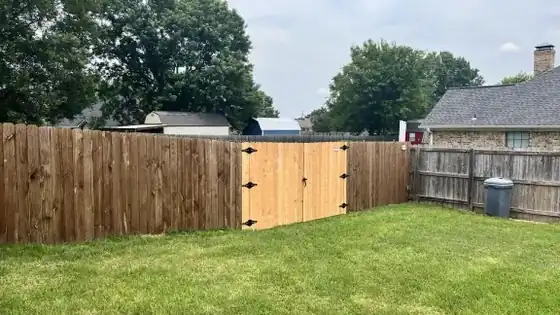
A fence rarely fails all at once. A thunderstorm leans one post a few degrees, a falling branch cracks a board, a gate starts dragging across the grass. Then the next storm comes through, and a small fix turns into a whole section lying in the yard. In Whitehouse, where plenty of fences have been standing a good while, most of what we repair comes down to catching that first lean or crack before it spreads.
At C W G Fence and Decks we repair wood, vinyl, chain link, and ornamental iron fences. Here is what goes wrong in East Texas and how to tell a repair from a replacement.
What storms and clay do to a fence
Two things cause most of the damage here: wind and the ground. A six-foot wall of wood boards catches wind like a sail, so any post that is even slightly loose in its footing gets tested every time a thunderstorm rolls through.
Then there is the clay. Clay soil swells when it is soaked and shrinks when it dries out, and that slow movement works against a fence post year after year. Posts set shallow, or set without enough concrete around them, tend to tilt first. You will see a section that leans one way, a gap opening under the boards, or a gate that used to close fine and now misses the latch.
Add impact from a backed-up truck or a fallen limb, rot where wood sits in wet ground, and rust on damp hardware, and you have the usual reasons a Whitehouse fence needs attention.
Walk the line after every big storm
A ten-minute walk beats a big repair bill. Stand at one end and sight down the top of the fence. Posts that have moved show up as a wobble in the line. Then push on each post with your hand. A solid post barely moves. A loose one rocks, and you can often see soil cracked in a ring around the base. Here is what to look for:
- Leaning or rocking posts, especially at corners and next to gates
- Boards that are cracked, split, or pulling away from the rails
- Dark, soft wood at the bottom of posts or boards, where a screwdriver tip sinks in easily
- Rust streaks, or screws and nails that have backed out
- Chain link that bows or sags between posts
- Vinyl panels that have popped out of their channels
Take a few photos with your phone. They help when you describe the problem and give you something to compare against after the next storm.
Repair or replace?
It depends on how much of the fence is still sound. If the damage is a handful of boards, one or two posts, or a single gate, repair is usually the sensible route. You keep the part that is working and you do not tear up the landscaping along the line.
If most of the posts lean, the wood is soft along the whole length, or the same sections keep failing, patching starts to cost more than it saves. We will tell you which side of that line your fence is on. That is part of the free estimate, and we would rather say "fix this part, leave the rest" than sell a fence you do not need. We do not use high-pressure sales tactics.
A leaning post always has a cause
Resetting a post without finding out why it leaned is how you end up fixing the same spot twice. There are usually three suspects: the footing was too shallow, the soil around it shifted or washed out, or the post rotted below ground where you cannot see it.
Each one gets a different fix. A sound post in a failed footing can be reset deeper with fresh concrete. A post that has rotted through gets replaced. If water pools at the base, the drainage needs attention too, or the new post will go the same way.
Gates, hardware, and the small stuff
Gates carry the most stress on any fence. They swing, they get slammed, and they hang their full weight from a single post. A sagging gate is often a post problem rather than a hinge problem, so tightening the hinges may only buy you a week. Resetting the hinge post, adding a brace, or replacing the hardware usually fixes it for good.
On wood fences we use corrosion-resistant fasteners for repairs, because plain nails and cheap screws rust in this humidity and the boards work loose again. A cracked vinyl panel generally comes out and a new one goes in. Chain link can be re-tensioned or have a damaged section of mesh replaced, and bent iron pickets can be straightened or swapped out.
How long it takes, and what to mention
Small jobs like re-securing boards or adjusting a gate can move quickly. Post replacement and panel rebuilding take longer, and the schedule depends on how many sections are involved and whether materials need to be ordered. If you have a dog that can squeeze through a gap, or a pool behind the fence, say so when you call, because that changes how soon it needs to be handled.
If your Whitehouse fence is leaning, cracked, or dragging, call (903) 316-3127, any day from 8 AM to 8 PM, and we will come look at it. Estimates are free, and military and senior citizen discounts are available.
Keep reading
Adding Curb Appeal with Ornamental Iron Fencing in Flint
Iron fencing frames a yard instead of hiding it, and the details you choose up front decide whether it still looks sharp in twenty years.
Choosing Low-Maintenance Vinyl Fencing for Your Bullard Home
Vinyl will not ask for a Saturday of staining every few years, but it is not the right fence for every yard.
Have a fence or deck in mind?
Tell us what you are looking at and we will come out, measure, and give you a free estimate.